
Digital Marketing Strategies That Drive Real Business Growth
In today’s competitive business environment, having a strong online presence is no longer optional. Customers search for products, compare services, read reviews, and make purchasing decisions online. Whether you run a small local business, an e-commerce store, or an established company, digital marketing can help you reach the right people at the right time. The key is not simply being visible online but using the right strategies to attract, engage, convert, and retain customers.
Digital Marketing Strategies That Drive Real Business Growth focus on combining different online marketing channels with clear business goals. Search engine optimization, paid advertising, social media marketing, content marketing, email marketing, and analytics can work together to create a powerful marketing system. When these channels are planned properly, businesses can improve visibility, generate quality leads, increase sales, and build long-term customer relationships.
Understanding Digital Marketing
Digital marketing refers to promoting a business, product, or service through digital channels. These channels include search engines, websites, social media platforms, email, online advertising, and other internet-based platforms.
Traditional advertising can still be useful, but digital marketing offers businesses the ability to target specific audiences and measure campaign performance. Marketers can understand where visitors come from, which advertisements receive attention, what content performs well, and which campaigns generate conversions.
One of the biggest advantages of digital marketing is flexibility. A business can start with a small budget, test different strategies, analyze the results, and improve campaigns based on actual performance.
Instead of marketing to everyone, businesses can identify their ideal customers and create campaigns specifically designed for them.
Why Digital Marketing Matters for Business Growth
Digital Marketing Strategies That Drive Real Business Growth
Consumers spend a significant amount of time online. They use search engines to find information, social media to discover brands, and websites to research products and services.
This creates a major opportunity for businesses.
A strong digital marketing strategy can help a company:
- Increase brand awareness
- Reach targeted customers
- Generate qualified leads
- Increase website traffic
- Improve customer engagement
- Build brand credibility
- Increase online sales
- Retain existing customers
- Measure marketing performance
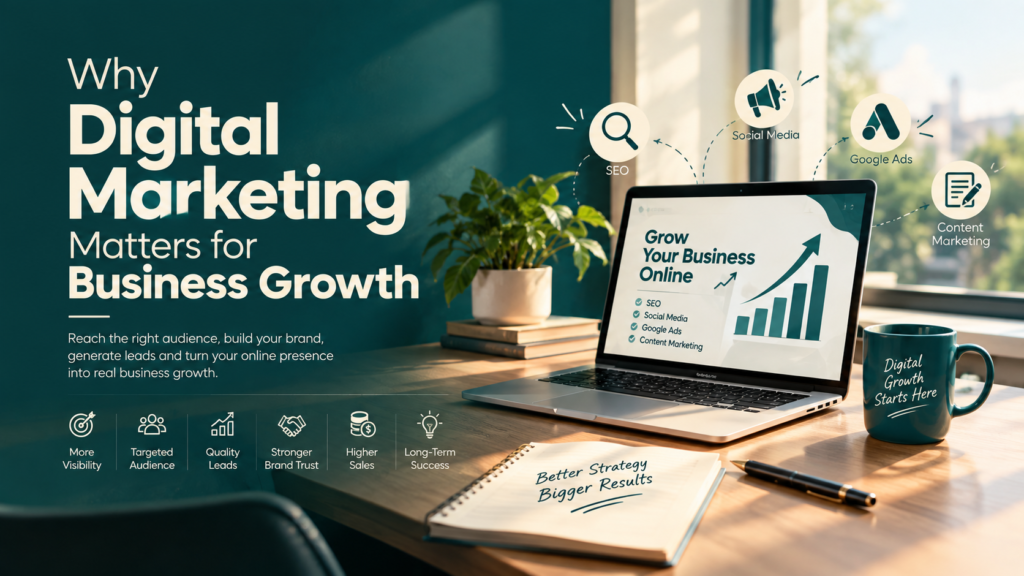
However, simply using multiple digital platforms does not guarantee success. Businesses need a strategy that connects their marketing activities to measurable objectives.
That is why Digital Marketing Strategies That Drive Real Business Growth should begin with understanding the business, its customers, competitors, and goals.
1. Build a Strong Website
Digital Marketing Strategies That Drive Real Business Growth
Your website is often the foundation of your digital marketing efforts. It acts as a digital storefront where potential customers can learn about your business, explore your services, and take action.
A professional website should have a clean design, simple navigation, fast loading speed, mobile-friendly functionality, and clear calls to action.
Your website should quickly answer important customer questions:
- What does your business offer?
- Who are your services for?
- Why should customers choose you?
- How can customers contact you?
- What action should visitors take next?
A website without a clear purpose can lose potential customers. Every important page should guide visitors toward a useful action, such as submitting a form, making a purchase, calling the business, or requesting information.
2. Use SEO to Increase Organic Visibility
Search Engine Optimization, commonly known as SEO, is one of the most important long-term digital marketing strategies.
SEO involves improving your website and content so that search engines can better understand and rank your pages for relevant searches.
For example, if someone searches for a digital marketing professional in a particular location, businesses with optimized websites have a better opportunity to appear in relevant search results.
SEO includes several areas:
- Keyword research
- On-page optimization
- Technical SEO
- Content creation
- Internal linking
- Local SEO
- Website performance
- Backlink development
The goal is not simply to get more traffic. The goal is to attract people who are genuinely interested in your products or services.
Effective SEO takes time, but it can create sustainable organic traffic and reduce dependence on paid advertising.
3. Create Valuable Content
Digital Marketing Strategies That Drive Real Business Growth
Content marketing is another important part of a successful digital marketing strategy.
People do not always purchase something the first time they discover a business. They often need information before making a decision.
Useful content can help answer their questions and establish your business as a trustworthy source.
Content can include:
- Blog articles
- Guides
- Videos
- Infographics
- Case studies
- Social media posts
- Tutorials
- Customer stories
- Frequently asked questions
Instead of creating content simply to fill a website or social media page, focus on solving customer problems.
For example, a digital marketing agency could create content explaining how businesses can improve SEO, reduce wasted advertising spend, generate leads, or improve social media engagement.
This type of educational content can attract potential customers while building credibility.
4. Invest in Google Ads
Digital Marketing Strategies That Drive Real Business Growth
SEO is valuable for long-term growth, but businesses may also need faster ways to reach potential customers. Google Ads can help businesses appear in front of people who are actively searching for relevant products or services.
A well-managed Google Ads campaign can target specific keywords, locations, audiences, devices, and other factors.
However, successful advertising is not simply about spending more money.
Campaign performance depends on factors such as:
- Keyword selection
- Search intent
- Ad copy
- Landing page quality
- Audience targeting
- Budget management
- Conversion tracking
- Continuous optimization
Businesses should monitor their campaigns regularly and identify which keywords and advertisements generate valuable results.
The objective should be to maximize business outcomes rather than simply generating clicks.
5. Grow Through Social Media Marketing
Digital Marketing Strategies That Drive Real Business Growth
Social media platforms provide businesses with opportunities to communicate directly with their target audience.
Platforms such as Instagram, Facebook, LinkedIn, and other networks can help businesses increase awareness, showcase products, share educational content, and build relationships.
Successful social media marketing requires consistency and relevance.
Businesses should understand what their audience wants to see rather than posting promotional messages constantly.
A strong social media strategy can include:
- Educational posts
- Short-form videos
- Customer testimonials
- Behind-the-scenes content
- Product demonstrations
- Industry insights
- Interactive content
- Promotional campaigns
The goal is to create meaningful interactions that gradually turn followers into customers.
6. Use Meta Ads for Targeted Campaigns
Digital Marketing Strategies That Drive Real Business Growth
Paid social advertising can provide businesses with powerful targeting opportunities.
Meta advertising allows businesses to promote content and offers to specific audiences based on factors such as interests, behaviors, demographics, and previous interactions.
Businesses can use campaigns for different objectives, including awareness, traffic, engagement, lead generation, and conversions.
However, effective advertising requires testing.
Different audiences, images, videos, headlines, and offers may produce different results. Marketers should monitor campaign data and optimize based on performance.
Testing multiple variations can help identify which message connects most effectively with the target audience.
7. Develop an Email Marketing Strategy
Digital Marketing Strategies That Drive Real Business Growth
Email marketing remains a valuable way to communicate directly with potential and existing customers.
Unlike social media platforms, where businesses depend on changing algorithms and user behavior, an email list provides a direct communication channel.
Businesses can use email marketing to send:
- Newsletters
- Product updates
- Special offers
- Educational content
- Event invitations
- Customer recommendations
- Follow-up messages
Personalization can make email campaigns more relevant. Instead of sending the same message to everyone, businesses can segment their audience based on interests, previous purchases, behavior, or customer journey stage.
Consistent and useful communication can strengthen customer relationships and encourage repeat business.
8. Focus on Local SEO
For businesses serving a specific geographic area, local SEO can be especially important.
Customers frequently search for services using location-based terms. For example, they may search for a digital marketer, restaurant, clinic, photographer, or service provider near their location.
Businesses should ensure that their online information is accurate and consistent.
Important local SEO activities include:
- Optimizing the business profile
- Maintaining accurate contact information
- Creating location-focused content
- Collecting genuine customer reviews
- Optimizing service pages
- Building relevant local citations
Local SEO can help businesses become more visible to customers who are searching for nearby services.
9. Use Analytics and Data
One of the strongest advantages of digital marketing is measurability.
Businesses can use analytics to understand how customers interact with their websites, advertisements, content, and campaigns.
Important metrics can include:
- Website traffic
- Conversion rate
- Cost per lead
- Click-through rate
- Engagement
- Return on advertising spend
- Customer acquisition cost
- Lead quality
Data should not simply be collected; it should be used to make decisions.
For example, if an advertising campaign receives many clicks but very few conversions, the problem may be the landing page, offer, targeting, or audience intent.
A data-driven approach allows marketers to identify weaknesses and improve performance.
Creating an Integrated Marketing Strategy
The most effective approach is usually not to depend on one marketing channel.
SEO can generate organic visibility. Google Ads can capture high-intent searches. Social media can build awareness and engagement. Content marketing can establish authority. Email marketing can nurture leads.
When these channels work together, they create a stronger customer journey.
For example, a potential customer may first discover a brand through a social media video. Later, they may search for the company on Google and visit its website. After reading a blog article, they may subscribe to an email list. Eventually, they may receive a useful offer and become a customer.
This demonstrates why Digital Marketing Strategies That Drive Real Business Growth should be viewed as a complete system rather than a collection of disconnected marketing activities.
Understanding Your Target Audience
Before launching a campaign, businesses need to understand their customers.
Important questions include:
- Who is the ideal customer?
- What problems do they have?
- What motivates their purchasing decisions?
- Where do they search for information?
- What objections prevent them from buying?
- What type of content do they prefer?
- What factors influence their trust?
Creating customer personas can help marketers develop more relevant campaigns.
When businesses understand their audience, they can create better advertisements, content, landing pages, and offers.
Building Trust Online
Trust plays an important role in modern purchasing decisions.
Customers may hesitate to purchase from a business if they cannot find enough information or evidence of credibility.
Businesses can build trust through:
- Professional website design
- Clear service information
- Customer testimonials
- Reviews
- Case studies
- Helpful content
- Transparent communication
- Consistent branding
Your online presence should make potential customers feel confident about choosing your business.
The Importance of Consistency
Digital marketing results rarely come from one campaign or one social media post.
Consistency is essential.
Businesses should maintain consistent branding, messaging, content creation, and audience engagement. Regular optimization is equally important.
Marketing trends change quickly, so businesses should review their strategies regularly.
A strategy that worked several years ago may not produce the same results today. Marketers need to monitor customer behavior, platform changes, search trends, and campaign performance.
Avoiding Common Digital Marketing Mistakes
Businesses can waste time and money when they approach digital marketing without a clear plan.
Common mistakes include:
- Targeting everyone instead of a specific audience
- Focusing only on vanity metrics
- Ignoring mobile users
- Creating low-quality content
- Running advertisements without tracking conversions
- Neglecting SEO
- Posting inconsistently
- Using outdated strategies
- Failing to test campaigns
- Ignoring customer feedback
Avoiding these mistakes can improve marketing efficiency and help businesses use their budgets more effectively.
Turning Leads Into Customers
Generating traffic is only one part of digital marketing.
Businesses also need to convert visitors into leads and customers.
A strong conversion strategy may include:
- Clear calls to action
- Simple contact forms
- Strong landing pages
- Compelling offers
- Customer reviews
- Easy navigation
- Fast website performance
- Follow-up campaigns
Every stage of the customer journey should be considered.
If thousands of people visit a website but very few contact the business, increasing traffic alone may not solve the problem. Improving the conversion process could have a greater impact.
Measuring Return on Investment
Digital marketing should ultimately support business objectives.
Before starting a campaign, define what success means.
For one business, success may mean generating leads. For another, it may mean increasing online sales, phone calls, bookings, or brand awareness.
Tracking return on investment helps businesses understand whether their marketing budget is producing meaningful results.
The best Digital Marketing Strategies That Drive Real Business Growth combine creativity with measurement. Great content and attractive advertisements are valuable, but businesses also need reliable data to understand whether those activities are contributing to their goals.
The Future of Digital Marketing
Digital marketing continues to evolve as technology and consumer behavior change.
Artificial intelligence, automation, personalization, short-form video, conversational marketing, and data-driven decision-making are becoming increasingly important areas for marketers.
However, technology alone will not guarantee success.
Businesses still need to understand their customers and provide genuine value.
The future belongs to brands that can combine technology with creativity, strategy, customer understanding, and consistent execution.
Final Thoughts
Digital marketing provides businesses with countless opportunities to reach new customers and build stronger relationships with existing ones. From SEO and content marketing to Google Ads, social media, email marketing, and analytics, each channel can contribute to business growth when used strategically.
The most important step is to create a clear plan based on your audience, objectives, budget, and available resources.
Digital Marketing Strategies That Drive Real Business Growth are not about following every trend or using every platform. They are about selecting the right channels, delivering valuable experiences, measuring performance, and continuously improving.
For businesses that want sustainable online growth, digital marketing should be treated as a long-term investment rather than a one-time activity.
Start by understanding your audience, build a strong digital foundation, create valuable content, use targeted advertising, track your results, and keep optimizing your strategy.
With the right approach, digital marketing can help transform online visibility into meaningful engagement, qualified leads, loyal customers, and measurable business growth.